CISA 2030 Named Three OT Problems. Open Standards Are the Architecture That Solves Them.
CISA 2030 asks operators to modernize OT, see their assets, and assure the supply chain. Closed architectures block all three. Open standards do not.
On October 26, CISA released CISA 2030: Defend, Harden, Prevail. For process industries, three key objectives inside the Defend pillar deserve a careful read.
The strategy commits CISA to work alongside critical infrastructure owners and operators to modernize OT environments, improve asset visibility and anomaly detection, and assure OT supply chain integrity. A second objective calls for data-driven guidance and best practices to drive software security and supply chain transparency.
That is not perimeter security language. It is language about what happens inside the control system. COPA has made that case before: cybersecurity has to be built into the control architecture, not bolted on.
The problem these three objectives share
All three face the same obstacle: closed, proprietary OT architecture.
Passive asset discovery tools cannot interrogate what they cannot communicate with. Supply chain validation is nearly impossible when the bill of materials for a controller lives inside a vendor's proprietary firmware. Anomaly detection requires a stable baseline, and you cannot build one when your systems do not share a common data model.
This is not a new problem. It is an old problem that now has a federal mandate attached to it.
What O-PAS provides that CISA now requires
The Open Process Automation Standard (O-PAS) is a vendor-neutral standard for industrial control systems. It defines how components from different manufacturers communicate, how system state is exposed, and how security boundaries are enforced.
Three O-PAS capabilities map directly to CISA's Defend objectives.
Interoperability. Any compliant component can exchange data with any other compliant component, regardless of manufacturer. This is the foundation. Without it, asset visibility and supply chain validation remain bolt-on problems with bolt-on costs.
KR4 connectivity. COPA's Key Requirement 4 defines how a Distributed Control Node (DCN) exposes its operational data to external consumers via a standard interface. That is precisely what CISA's asset visibility mandate requires: real-time, standards-based access to system state, without vendor-specific adapters or renegotiated service contracts. You cannot detect anomalies in systems you cannot read.
Supply chain transparency. In an open-standards environment, component identity and behavior are specified in published documents, not locked in firmware. A hardware or software component either conforms to the published interface or it does not. That is auditable. Proprietary integration is not.
The interoperability thread in Pillar 3
The Prevail pillar adds a second signal worth noting. CISA commits to building next-generation, interoperable infrastructure that enables integrated operation and ensures continuity of essential functions in the event of disruption. Interoperability is not only an OT security term in this document. It is a stated design requirement for the national resilience model CISA is building toward.
O-PAS is already that architecture. An independent government team assessed the COPA 500 at Camp Roberts and, within the test window, found no vulnerabilities that enabled unauthorized interaction with its control functions.
What the implementation timeline means in practice
CISA 2030 sets a 365-day commitment: within one year, the agency will deliver a progress update on outcomes aligned to its three pillars. OT modernization, asset visibility, and supply chain integrity are all tracked under Pillar 1. This will translate into guidance, funding criteria, and partner expectations that flow downstream to operators and integrators.
Operators who begin moving toward O-PAS-compliant systems now build toward a posture CISA will increasingly expect. Integrators who can demonstrate O-PAS alignment have a defensible position in a procurement environment that is about to get more structured.
The standard exists. The federal mandate now exists. The architecture question is which side of the proprietary divide your next system sits on.
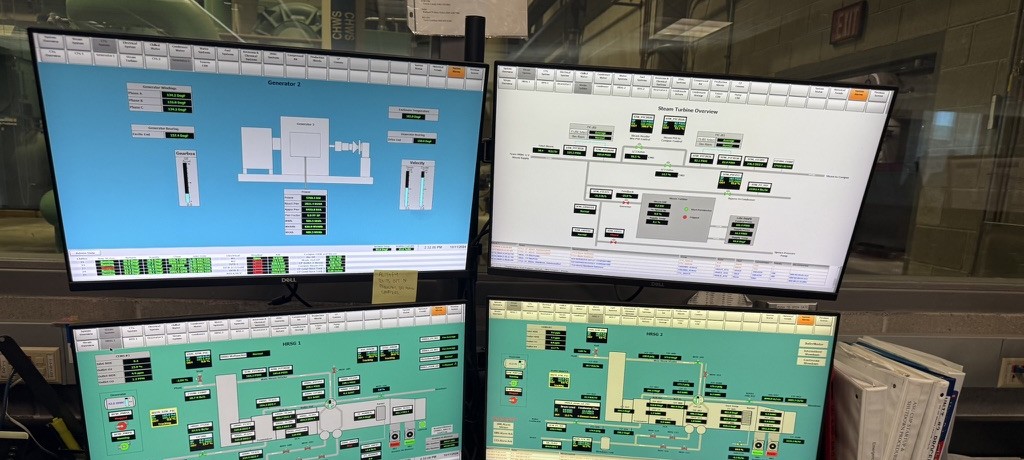
Photograph: plant control desk with live process graphics for a generator, a steam turbine, and heat-recovery units. Dedicated to the public domain (CC0) by Rsparks3 via Wikimedia Commons.
